
Our Approach
Surviving records of a practice, whether they be texts or tools, will typically be in the everyday language context of the practitioners. Texts and tools which were in circulation in "vernacular" are major sources for our learnings. Various Indian (broad) language traditions have extensive records and artefacts which speak to everyday practices of different professionals and their pedagogic contexts. However, these are rarely historically scrutinised or even catalogued.
Through various collaborative efforts, this archive tries to bring such materials together for the interested public, whether professional academics or others, to explore, ask questions, and reconstruct narratives of mathematical practices as well as the various relationalities between practices and the general public. We feel this is particularly important in the subcontinent, where occupational practices became one of the axes around which the graded hierarchy of caste was organised and vice versa; where there was a separation of mental and manual labour. Our archive is also an attempt to demonstrate how knowledge and practice are mutually constituted.
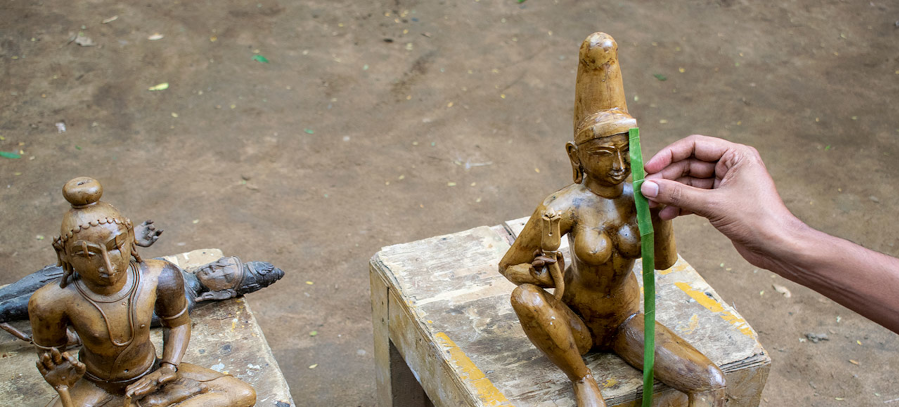
That said, archival records such as palm leaf manuscripts,texts, inscriptions, tools, and instruments,removed from their sites of practice, are only fragments of the past. By contextualising these records, through social histories , ethnographies, conversations with practitioners or their descendants, reflections on the public subjected to these practices, and by enlivening them through practical reproduction, we begin to understand the social and political worlds which constituted such practices and in turn how such practices shaped the social and political. Our learnings suggest that interrogating the relations between texts, practitioners, and practices, can help understand computational practices in their everyday socio-political contexts [See Babu, 2022]. Texts (like Kanakkatikaram) embody such relationalities.
Through years of collaborative efforts involving a diverse set of people with varying expertise, we curate and present the tools, texts, and records of various practitioners such as teachers, artisans, village and merchant accountants, in different language traditions within India. The curated information spans between 9th century CE to 20th century CE and constitutes primary sources like palm leaf manuscripts, paper manuscripts, metrological instruments, and associated field work documents etc.