
Introduction to the Archive
We often say Mathematics is everywhere. While this may be debatable, what is clear is that, many occupational contexts involve mathematical and computational activities like manipulating numbers, extracting roots, representing perspective in pictures, compounding proportions, arranging numbers in tables, following rules and algorithmic procedures, knitting propositions together, visualising magnitudes in geometric diagrams, solving problems, measuring fields with specific instruments, drawing curves, making deductions and plotting the routes of ships, accounting practices etc [Adapted from Senthil Babu, 2022].
It is also through such occupational contexts that Mathematics become part of our social lives. However, when discussing the history of mathematics we often focus only on the development of the discipline of mathematics and less on practice contexts. Through this archive we ask questions such as, What would the history of mathematics look like if viewed from the perspective of those deeply engaged in computational practices, like the village accountant? Where does the accountant or the trader belong in the history of computation? Where do the students and the teachers fit within this landscape? And so on.
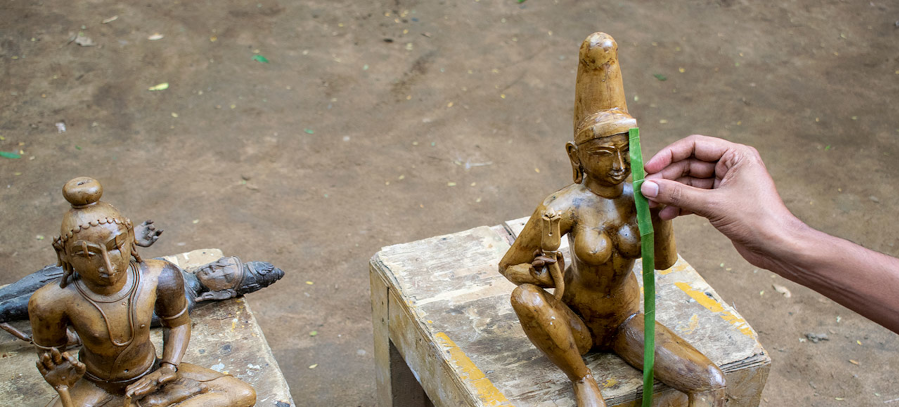
By examining the texts, tools and practices of various occupations such as; Teaching, Carpenting, Sculpting, Boat making, Accounting, Metal working, Astrology and so on in their social, historical and political contexts, we may begin to learn how mathematical and computational practices were/are weaved into the social.
Our inquiries, in particular, have focused on making visible the relationships between text, practice, and the practitioner--or, more specifically, between schooling, work, and people. How the mathematics learned at the tinnai enters the lives of the village public through the functions of the village accountant is something well documented by Dr. Senthil Babu. The ways in which value, measurement, and calculation are related, that is how a measure produced through the physical act of measuring is transformed into an abstract value through computation, is another prominent theme we are exploring in our historical studies.
The Tamiḻ and Malayalam word, kaṇakku which simultaneously means calculation, accounting, mathematics, or, in a compound, calculator/accountant/mathematician, (Wagner & Ashokan, 2024) possibly best captures our spirit.