What may we learn if we view mathematics as a set of practices such as estimating, measuring, counting, proportioning, and so on, and as embedded in practices like sculpting, teaching, accounting, and more? What does this reveal about the role of computational and mathematical practices in shaping our social and political lives?
This archive showcases our ongoing explorations of these questions, particularly in the context of South India. We welcome you to engage with our materials, ask questions, and enrich the archive. Please reach out if you'd like to contribute.
Explore
Advanced search...We often say Mathematics is everywhere. While this may be debatable, what is clear is that, many occupational contexts involve mathematical and computational activities like manipulating numbers, extracting roots, representing perspective in pictures, compounding proportions, arranging numbers in tables, following rules and algorithmic procedures, knitting propositions together, visualising magnitudes in geometric diagrams, solving problems, measuring fields with specific instruments, drawing curves, making deductions and plotting the routes of ships, accounting practices etc [Adapted from Senthil Babu, 2022].
It is also through such occupational contexts that Mathematics become part of our social lives. However, when discussing the history of mathematics we often focus only on the development of the discipline of mathematics and less on practice contexts. Through this archive we ask questions such as, What would the history of mathematics look like if viewed from the perspective of those deeply engaged in computational practices, like the village accountant? Where does the accountant or the trader belong in the history of computation? Where do the students and the teachers fit within this landscape? And so on.
By examining the texts, tools and practices of various occupations such as Teaching, Carpenting, Sculpting, Boat making, Accounting, Metal working, Astrology and so on in their social, historical and political contexts, we may begin to learn how mathematical and computational practices were/are weaved into the social.
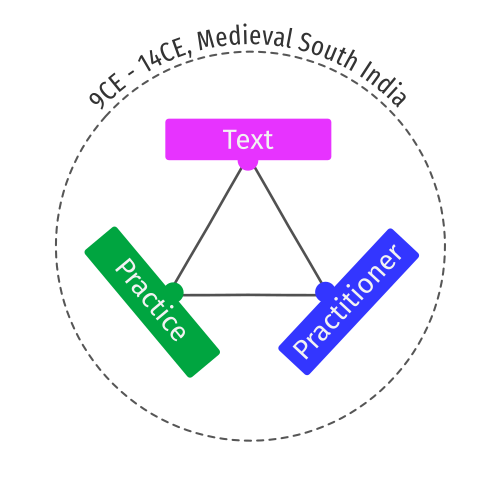
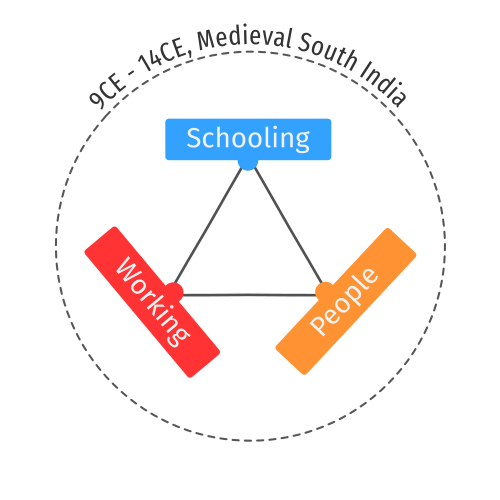
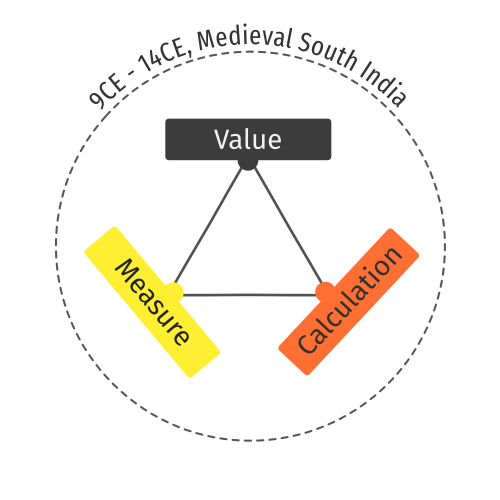
Our inquiries, in particular, have focused on making visible the relationships between text, practice, and the practitioner—or, more specifically, between schooling, work, and people. How the mathematics learned at the tinnai enters the lives of the village public through the functions of the village accountant is something well documented by Dr. Senthil Babu. The ways in which value, measurement, and calculation are related, that is how a measure produced through the physical act of measuring is transformed into an abstract value through computation, is another prominent theme we are exploring in our historical studies.
The Tamiḻ and Malayalam word, kaṇakku which simultaneously means "calculation," "accounting," "mathematics," or, in a compound, "calculator/accountant/mathematician," (Wagner & Ashokan, 2024) possibly best captures our spirit.
Surviving records of a practice, whether they be texts or tools, will typically be in the everyday language context of the practitioners. Texts and tools which were in circulation in 'vernacular' are major sources for our learnings. Various Indian (broad) language traditions have extensive records and artefacts which speak to everyday practices of different professionals and their pedagogic contexts. However, these are rarely historically scrutinised or even catalogued.
Through various collaborative efforts, this archive tries to bring such materials together for the interested public, whether professional academics or others, to explore, ask questions, and reconstruct narratives of mathematical practices as well as the various relationalities between practices and the general public. We feel this is particularly important in the subcontinent, where occupational practices became one of the axes around which the graded hierarchy of caste was organised and vice versa; where there was a separation of mental and manual labour. Our archive is also an attempt to demonstrate how knowledge and practice are mutually constituted.
That said, archival records such as palm leaf manuscripts,texts, inscriptions, tools, and instruments,removed from their sites of practice, are only fragments of the past. By contextualising these records, through social histories , ethnographies, conversations with practitioners or their descendants , reflections on the public subjected to these practices, and by enlivening them with practical reproduction, we begin to understand the social and political worlds which constituted such practices and in turn how such practices shaped the social and political. Our learnings suggest that interrogating the relations between texts, practitioners, and practices, can help understand computational practices in their everyday socio-political contexts [See Babu , 2022]. Texts (like Kanakkatikaram) embody such relationalities.
Through years of collaborative efforts involving a diverse set of people with varying expertise, we curate and present the tools, texts, and records of various practitioners such as teachers, artisans, village and merchant accountants, in different language traditions within India. The curated information spans between 9th century CE to 20th century CE and constitutes primary sources like palm leaf manuscripts, paper manuscripts, metrological instruments, and associated field work documents etc.
We and some of our collaborators have engaged with certain practices and materials in depth, scrutinised them in context, and published edited versions of the associated texts . However, most objects and texts in our collection await deeper engagement, especially the large collection of images of measuring instruments from parts of South India collected from various museums
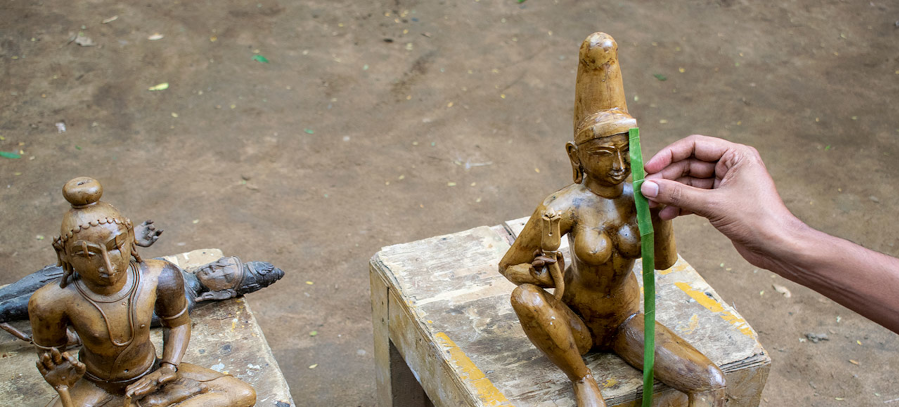
You may share your learning through our storyscape page as many in the past have done. In that sense we envision this archive to be an ever growing contextualised evidence repository, for illuminating the space of practices grounded in a particular geographical and temporal scope. The work on Kaṇakkatikāram texts , Encuvati and Muthukaṇakku serves as one possible model of inquiry; another is to follow practices of measuring and instruments in their actual contexts —to make them live again, rather than remain archival and static. This means conducting social ethnographies with makers of those tools, those subjected to them, and even putting those instruments to the test by ourselves