Mathematical texts of Tiṇṇai Schools
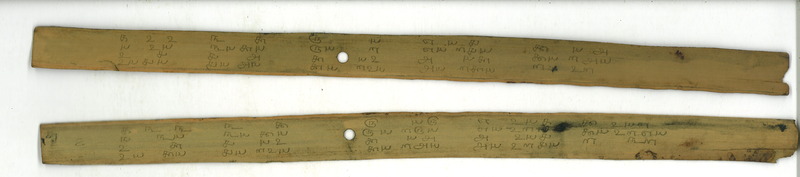
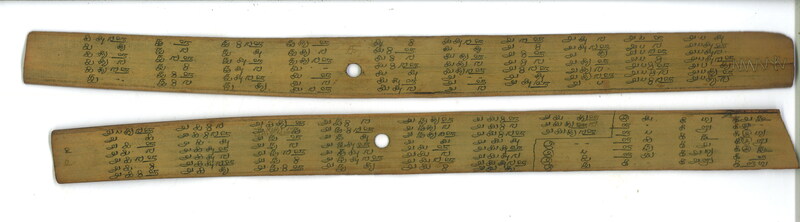
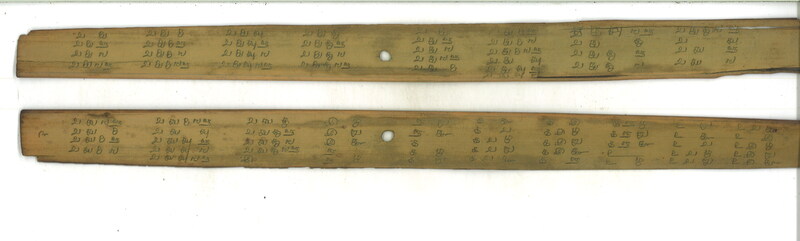
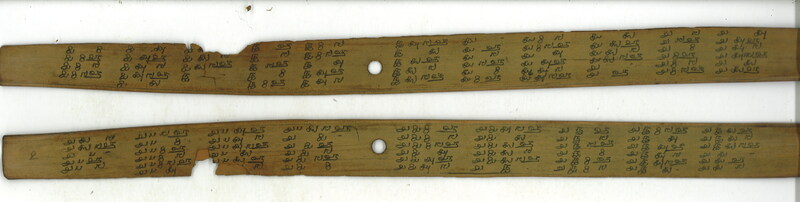
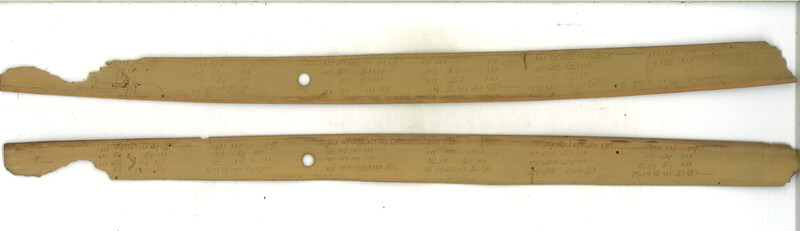
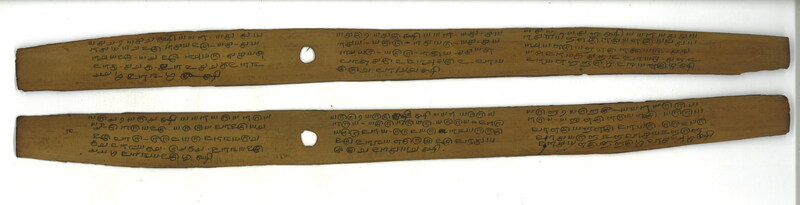
Poṉṉilakkam (Tamil number primer) and Nellilakkam (measures primer), Eṇcuvaṭi (multiplication tables), Kuḻimāttu (tables of squares for land measurement) were part of mathematics learning in tiṇṇai schools. These were not textbooks in the modern sense, but functioned like a manual, which wasn’t given to the students beforehand. However, upon gaining sufficient skills, each student produced their own palm leaf books, acquiring a book for 'himself' in the process. Reaching this stage was considered as becoming proficient in the Tamil number system, called muntiri ilakkam. The numbers were recorded using Tamil numerical notations. Our collection includes eṇcuvaṭis and other texts curated from different sources and locations. For a detailed description of the nature of these texts and social functions, see Senthil Babu (2022). The possible individual differences between these texts and a detailed analysis of learning as memorisation (as Babu describes it) are possible avenues one can further inquire into. The type of computations and exercises described in these texts and the logic of their organisation etc. may also be studied further.
Usually, all four texts are found bunched together. Different authors have often named their bunches differently, some has named their whole bunch as Encuvati, some as Munthiri Ilakkanam, some as Munthiri Vaypaadu, and so on. In some cases, there is only Nellilakkam, Ponnilikkam, Encuvati, or Kulimatru as a standalone manuscript.
Poṉṉilakkam (pon = gold; ilakkam = number place, in the literal sense) introduced numbers in ordered patterns, encompassing large whole numbers, fractions expressed as additive series, and standard units that doubled as both numbers and measures. For instance, the numbers Muntiri (1/320), Kāṇi (1/80), and Mā (1/20) were also land measures. It also expressed standard fractions in terms of each other (Muntiri + muntiri = araikkāṇi; Araikkāṇi + muntiri = araikkāṇiyē muntiri and so on).
The Nellilakkam (nel = paddy; ilakkam – number place) similarly presented grain measure units in iterative addition sequences with standardized notation, where the basic unit of grain measure, the ceviṭu, would become the number to be added repeatedly until the highest unit, the kalam, was reached (One ceviṭu + one ceviṭu = iru ceviṭu; Iru ceviṭu + one ceviṭu = mucceviṭu...).
The Eṇcuvaṭi was a compilation of several kinds of multiplication tables. All the numbers learnt during the course of Poṉṉilakkam and Nellilakkam would be subjected to multiplication with each other, to yield an entire set of tables that was to be committed to memory.
The last section in the learning of mathematics in the tiṇṇai school was the learning of tables of squares, called the Kuḻimāttu. Kuḻi is a square unit for the measure of land, whose higher units were mā, kāṇi, or veli in certain regions. In Kuḻimāttu, students memorized the table of squares.
Students typically took about two years to master these series, culminating in the ability to write their own manuals from memory on palm leaves, transforming natural memory into cultivated memory within an oral-mnemonic learning context.